
Author name: Michael Moore
Summery:
Cytokines and chemokines play a central role in immune response regulation and disease progression. This article explains their biological functions, classification, and clinical significance across conditions such as infections, cancer, and inflammatory diseases. It also explores how cytokine profiling supports diagnostics, disease monitoring, and the development of targeted therapies.
key Highlights:
Explain roles of cytokines and chemokines in immune system regulation
Classify chemokine subfamilies and their receptor-mediated signalling pathways
Analyse cytokine involvement in inflammatory diseases infections and cancer progression
Explore clinical applications including diagnostics biomarker discovery and therapeutic targeting
Identify importance of cytokine profiling in disease differentiation and patient monitoring
Cytokines and chemokines are referred to as immune-modulating agents that intercede and amend the responses of the system. The term “cytokine” is generated by two different Greek words: “cyto” meaning cell and “kinos” meaning movement. On the other hand, “chemokines” is a family unit of small cytokines, secreted by cells. Cytokines play an important role in immune-related concerns, traumas, and anything associated with disease and health.
Cytokines and chemokines are superfluous secreted proteins with growth, differentiation, and activation functions. They standardize and determine the characters of the immune response, control group immune cell trafficking and therefore, the cellular arrangement of immune organs.
A cascade of responses is often seen related to cytokines; sometimes, several cytokines are required to synergize precise optimal function. A further perplexing variable in dissecting cytokine function is that every cytokine may have a different process.
Counting on the cellular source, target, and, most vital specific phase of the immune reaction during which it’s presented. Numerous cytokines have both pro-inflammatory and anti-inflammatory potential. Which activity is observed depends on the immune cells present and their state of responsiveness to the cytokine.
As of today, about 50 human chemokines are discovered, and they might be classified into four subfamilies (C, CC, CXC, and CX3C). The activation of chemokine-mediated pathways requires selective binding of chemokines to chemokine receptors which are expressed on surfaces of target cells. M Cytokine is the general term to describe small protein mediators produced by immune cells.
Generally, cytokines include the interleukins (IL), interferons (IFN), chemokines and tumour necrosis factor (TNF). Cytokines can act on several cells and play a spread of roles like in inflammation and cellular differentiation. It’s been shown that cytokines enhance or suppress the assembly of other cytokines3–5.
Therefore, it’s essential to specialize in cytokine networks to reveal the complicated, inflammatory pathogenesis in sepsis. Cytokine networks in chronic inflammatory diseases like atrophic arthritis have already been clarified, and effective cytokine-targeted therapies are developed.
Clinical significance
1.Tuberculosis, Pneumonia: Even though these studies suggest a definite cytokine profile in identifying VAP. It is necessary to distinguish the condition from Tb; fortunately, there are similar clinical signs and symptoms. One of the foremost widely analyzed areas of clinical cytokine is within the diagnosis of TB.
2.Surgical Site Infections: A combination of different infection pathologies is connected with cytokines. However, only a few are conventional as predicted by a particular cytokine. Infectious diseases like periprosthetic joint infection (PJI) possibly will be at risk after surgery for shoulder arthroplasty. It is considerably challenging to diagnose realizing the scarcity of biomarkers to differentiate between septic and aseptic outcomes.
3.Alzheimer’s disease and Neurological Outcomes in asystole Patients: Alzheimer’s Disease (AD) is well recognized as a disease caused by Inflammatory processes. Cit and cytokines have been drawn in its aetiology.
4.Gastric Cancer: Gastric cancer is an additional condition defined by an abnormal cytokine profile. Cytokines are used to identify cancer, and also the identification of other ailments. It sets a cutoff of a specific percentile instead of taking into account ROC statistical analysis for diagnostic efficacy.
5.Lupus Nephritis & Lymphohistiocytosis: Lupus nephritis and lymphohistiocytosis are chronic conditions of immune system deficiency. Lupus nephritis has been related to immune markers, including cytokines.
6.Plerixafor (Mozobil): Drafted for anti-HIV treatment is a robust CXCR4 antagonist that mobilizes hematopoietic stem cells.
7.Coronavirus disease 2019 (COVID-19) is caused by severe acute respiratory syndrome coronavirus 2 (SARS-CoV-2. Some COVID-19 patients experience severe symptoms of acute respiratory distress syndrome (ARDS), which has a high mortality. This high severity seems dependent on a cytokine storm, probably induced by the interleukin-6 (IL-6) amplifier. The cytokine storm and CRS in fatal COVID-19 cases are represented by several pathological features including ARDS, coagulation, and multi-organ dysfunctions.
8.Maraviroc: Maraviroc is a noncompetitive CCR5 antagonist that anticipates the binding of HIV envelope glycoprotein to CCR5. The medication of HIV-infected patients with CCR5 tropism, maraviroc-based regimen offers 70% to 79% of virologic response (HIV-1 RNA)
Cytokines in the body
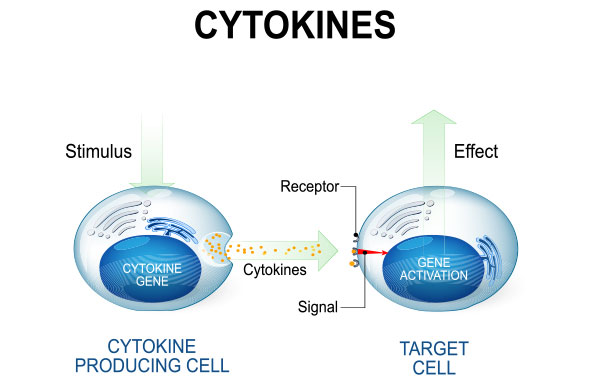
There is an ever-increasing number of tentative chemokine antagonists against most chemokine receptors. Potential chemokine receptor antagonists treat a wide variety of human diseases.
Conclusion
The establishment of clinical cytokine for diverse conditions could also be assisted by future improvement in our understanding of average cytokine profiles. To raise and understand, determine cytokine levels and diagnostic cutoffs in disease states, it’s essential first to characterize normal cytokine and chemokine levels in various populations. This will enable us to know how cytokines interact and modulate in different biochemical pathways in healthy individuals.
Significantly, the lack of research in specific diseases’ areas prevents the application of cytokines in diagnosis, gaining a far better understanding of basic cytokine profiles. It also will allow confirmation and supplementation or reconsideration, of diagnoses made through other diagnostic methods and clinical presentations.
Further, as usual, and diagnostic for these biomarkers be decoded, cytokines could be considered to upgrade patient outcomes when a definitive diagnosis is not possible with clinical features alone. Most diseases have very similar clinical features, and thus the establishment of pathological cytokine profiles may aid in the differentiation of such conditions.
To learn more about cytokines and chemokines contact Helvetica Health Care.
Frequently Asked Questions:
What are cytokines and chemokines and how do they function?
Cytokines and chemokines are small proteins that regulate immune responses by controlling cell signalling, inflammation, and immune cell movement. Cytokines influence cell growth and activation, while chemokines guide immune cell trafficking. Together, they coordinate the body’s response to infection, injury, and disease.
Why are cytokines important in disease diagnosis and monitoring?
Cytokines are important biomarkers because their levels change in response to disease processes. Abnormal cytokine profiles can indicate inflammation, infection, or immune dysfunction. Monitoring these levels helps clinicians assess disease progression, evaluate treatment response, and improve diagnostic accuracy.
What is a cytokine storm and why is it dangerous?
A cytokine storm is an excessive immune response where large amounts of cytokines are released rapidly. This can lead to severe inflammation, tissue damage, and organ failure. It has been observed in conditions such as severe COVID-19 and can significantly increase mortality risk if not managed effectively.
How are cytokines used in clinical and therapeutic applications?
Cytokines are used in diagnostics as biomarkers and in therapy as targets for treatment. Drugs that block or enhance specific cytokines can help manage inflammatory diseases, autoimmune conditions, and cancers. Cytokine-targeted therapies are increasingly used in precision medicine approaches.
What role do chemokines play in immune cell movement?
Chemokines direct the migration of immune cells to sites of infection or injury by binding to specific receptors on cell surfaces. This process ensures that immune cells reach affected tissues efficiently, supporting targeted immune responses and effective inflammation control.
About the Author: Michael Moore is Director of Sales and Marketing at Helvetica Health Care, a global supplier of high-quality biotechnology products operating from its ISO 13485:2016 certified distribution center in Geneva. With 35 years experience in sales, marketing, and international trade, he focuses on expanding global reach, strengthening customer relationships, and supporting efficient delivery and logistics across all continents.